ESP32-C6-WROOM-1
WROOM module · based on ESP32-C6 · Active
- RISC-V
- 1× @ 160 MHz
- Wi-Fi 6
- BLE 5.x
- 802.15.4
- 4 / 8 / 16 MB flash
- 23 GPIO
- PCB antenna
As an affiliate we may earn from qualifying purchases. Prices and availability are set by AliExpress.
Interactive 3D model · drag to rotate
Every figure here is checked against Espressif’s official datasheets. We’ve taken every care to keep it accurate — but datasheets are dense and mistakes happen, so if something looks off, please report it.
The ESP32-C6-WROOM-1 is a general-purpose Espressif module built on the ESP32-C6 single-core RISC-V SoC clocked up to 160 MHz. It pairs 2.4 GHz Wi-Fi 6, Bluetooth LE and 802.15.4 (Thread/Zigbee) with up to 16 MB flash, routes the radio to a PCB antenna, and breaks out 23 GPIO; the module measures 18 × 25.5 × 3.1 mm.
With Wi-Fi 6 plus 802.15.4, it suits Matter products and low-power mesh networks that also need an IP uplink. Secure boot and flash encryption are available for production security. Espressif lists target uses including Smart Home, POS Machines, Industrial Automation, Service Robot and Health Care.
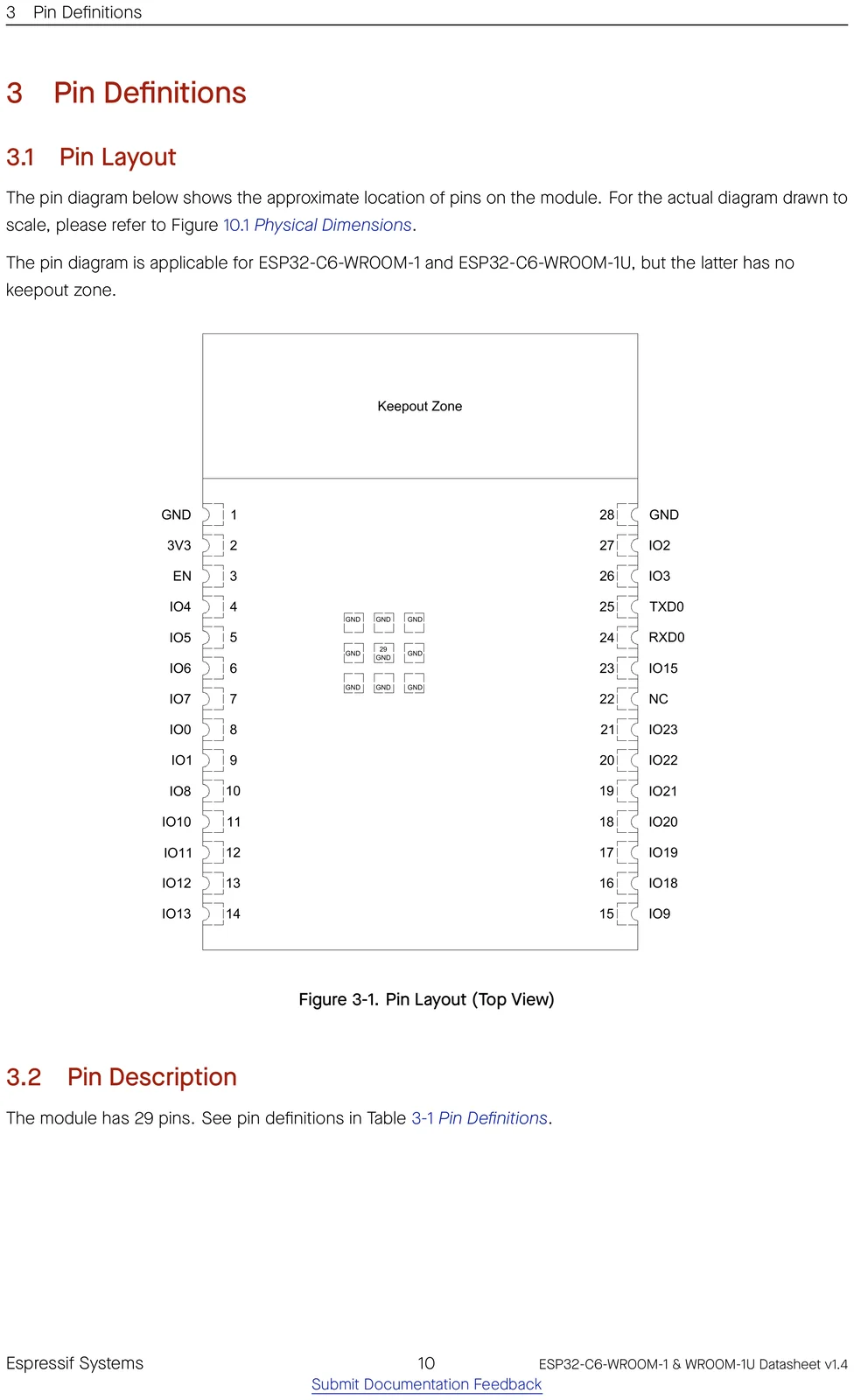
Pinout
⚑ flag an error| # | Name | Type | Functions | |
|---|---|---|---|---|
| 1 | GND | P | Ground | ⚑ |
| 2 | 3V3 | P | Power supply | ⚑ |
| 3 | EN | I | Chip enable | ⚑ |
| 4 | IO4 | I/O/T | MTMS, GPIO4, LP_GPIO4, LP_UART_RXD, ADC1_CH4, FSPIHD | ⚑ |
| 5 | IO5 | I/O/T | MTDI, GPIO5, LP_GPIO5, LP_UART_TXD, ADC1_CH5, FSPIWP | ⚑ |
| 6 | IO6 | I/O/T | MTCK, GPIO6, LP_GPIO6, LP_I2C_SDA, ADC1_CH6, FSPICLK | ⚑ |
| 7 | IO7 | I/O/T | MTDO, GPIO7, LP_GPIO7, LP_I2C_SCL, FSPID | ⚑ |
| 8 | IO0 | I/O/T | GPIO0, XTAL_32K_P, LP_GPIO0, LP_UART_DTRN, ADC1_CH0 | ⚑ |
| 9 | IO1 | I/O/T | GPIO1, XTAL_32K_N, LP_GPIO1, LP_UART_DSRN, ADC1_CH1 | ⚑ |
| 10 | IO8 | I/O/T | GPIO8 | ⚑ |
| 11 | IO10 | I/O/T | GPIO10 | ⚑ |
| 12 | IO11 | I/O/T | GPIO11 | ⚑ |
| 13 | IO12 | I/O/T | GPIO12, USB_D- | ⚑ |
| 14 | IO13 | I/O/T | GPIO13, USB_D+ | ⚑ |
| 15 | IO9 | I/O/T | GPIO9 | ⚑ |
| 16 | IO18 | I/O/T | GPIO18, SDIO_CMD, FSPICS2 | ⚑ |
| 17 | IO19 | I/O/T | GPIO19, SDIO_CLK, FSPICS3 | ⚑ |
| 18 | IO20 | I/O/T | GPIO20, SDIO_DATA0, FSPICS4 | ⚑ |
| 19 | IO21 | I/O/T | GPIO21, SDIO_DATA1, FSPICS5 | ⚑ |
| 20 | IO22 | I/O/T | GPIO22, SDIO_DATA2 | ⚑ |
| 21 | IO23 | I/O/T | GPIO23, SDIO_DATA3 | ⚑ |
| 22 | NC | — | NC | ⚑ |
| 23 | IO15 | I/O/T | GPIO15 | ⚑ |
| 24 | RXD0 | I/O/T | U0RXD, GPIO17, FSPICS1 | ⚑ |
| 25 | TXD0 | I/O/T | U0TXD, GPIO16, FSPICS0 | ⚑ |
| 26 | IO3 | I/O/T | GPIO3, LP_GPIO3, LP_UART_CTSN, ADC1_CH3 | ⚑ |
| 27 | IO2 | I/O/T | GPIO2, LP_GPIO2, LP_UART_RTSN, ADC1_CH2, FSPIQ | ⚑ |
| 28 | GND | P | Ground | ⚑ |
| 29 | EPAD | P | Ground | ⚑ |
Official datasheet pin-layout figure
Find a pin by function
Pick a capability to see which GPIOs provide it on the ESP32-C6.
Freely usable, no special role.
UART, I²C, SPI (master), I²S, PWM/LEDC and most digital peripherals route through the GPIO matrix — assign them to any pin from “Safe GPIO”. The categories above are the pins tied to a fixed function (analog, USB, crystal…) or that need care.
Strapping pins
⚑ flag an errorGPIOs sampled at reset — avoid driving these at power-up.
| Pin | Default | Bit | Function |
|---|---|---|---|
MTMS | floating | — | jtag |
MTDI | floating | — | jtag |
GPIO8 | floating | — | rom_log |
GPIO9 | pull-up | 1 | boot_mode |
GPIO15 | floating | — | usb_jtag |
GPIO pin warnings
⚑ flag an errorOn the ESP32-C6, almost any peripheral can be routed to almost any GPIO through the IO MUX, so most pins are free to use. These are the exceptions — pins with a fixed role or a boot-time behaviour to design around.
| Pin | Why it needs care |
|---|---|
GPIO4 | strapping pin (affects boot); JTAG |
GPIO5 | strapping pin (affects boot); JTAG |
GPIO6 | JTAG |
GPIO7 | JTAG |
GPIO8 | strapping pin (affects boot) |
GPIO9 | strapping pin (affects boot) |
GPIO12 | native USB D± |
GPIO13 | native USB D± |
GPIO15 | strapping pin (affects boot) |
GPIO16 | UART0 console (boot log) |
GPIO17 | UART0 console (boot log) |
Compute & memory
⚑ flag an error| CPU | RISC-V, 1-core |
|---|---|
| Max clock | 160 MHz |
| SRAM | 512 KB |
| ROM | 320 KB |
| Flash options | 4 / 8 / 16 MB |
| PSRAM | None |
| Co-processor | ULP-RISC-V |
Wireless
⚑ flag an error| Wi-Fi | Wi-Fi 6 |
|---|---|
| Wi-Fi bands | 2.4GHz |
| Bluetooth | BLE 5.x |
| 802.15.4 (Thread/Zigbee) | Yes |
| Antenna | PCB |
Peripherals & I/O
⚑ flag an error| Usable GPIO | 23 |
|---|---|
| ADC | 7× 12-bit |
| USB | USB-Serial-JTAG |
| UART / SPI / I²C / I²S | 2 / 1 / 2 / 1 |
| TWAI (CAN) | Yes |
| SD/MMC | Yes |
| Ethernet MAC | No |
| Touch | 0 |
Power
⚑ flag an error| Operating voltage | 3.0-3.6 V |
|---|---|
| Deep sleep | 7 µA |
Physical
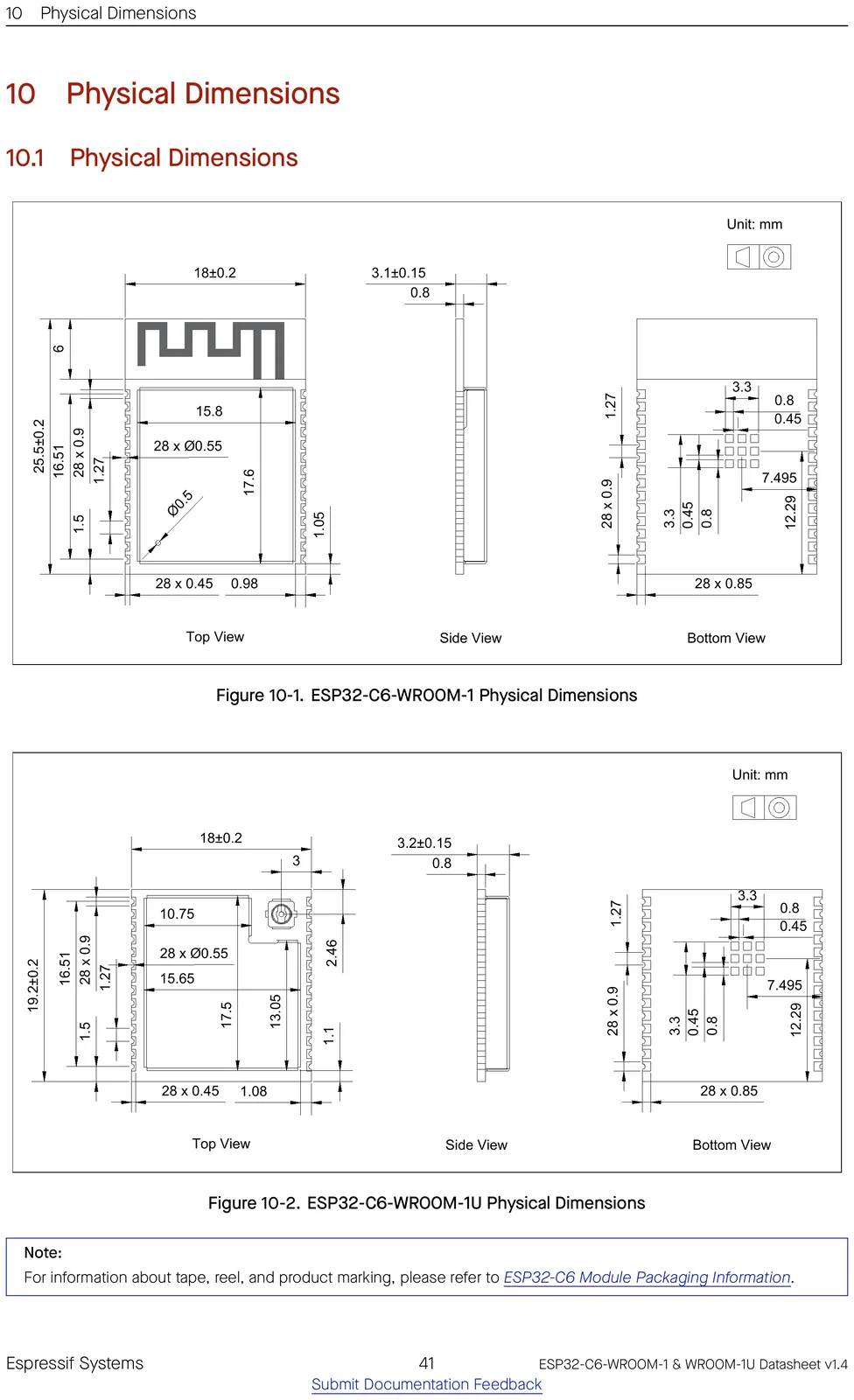
⚑ flag an error| Dimensions | 18 × 25.5 × 3.1 mm |
|---|---|
| Pin count | 29 |
| Temp range | -40 to 85 °C |
| Mounting | SMD castellated |
| Lifecycle | Active |
Security
⚑ flag an error| Secure boot | Yes |
|---|---|
| Flash encryption | Yes |
| Crypto | AES, SHA, RSA, HMAC, ECC, RNG |
| Digital signature | Yes |
| TRNG | Yes |
Ordering codes
⚑ flag an errorThe orderable part numbers and what each ships with — decoded from the suffix. Confirm against the latest datasheet before ordering.
| Part number | Flash | PSRAM | Temp |
|---|---|---|---|
ESP32-C6-WROOM-1-N4 | 4 MB | — | −40 to 85 °C |
ESP32-C6-WROOM-1-N8 | 8 MB | — | −40 to 85 °C |
ESP32-C6-WROOM-1-N16 | 16 MB | — | −40 to 85 °C |
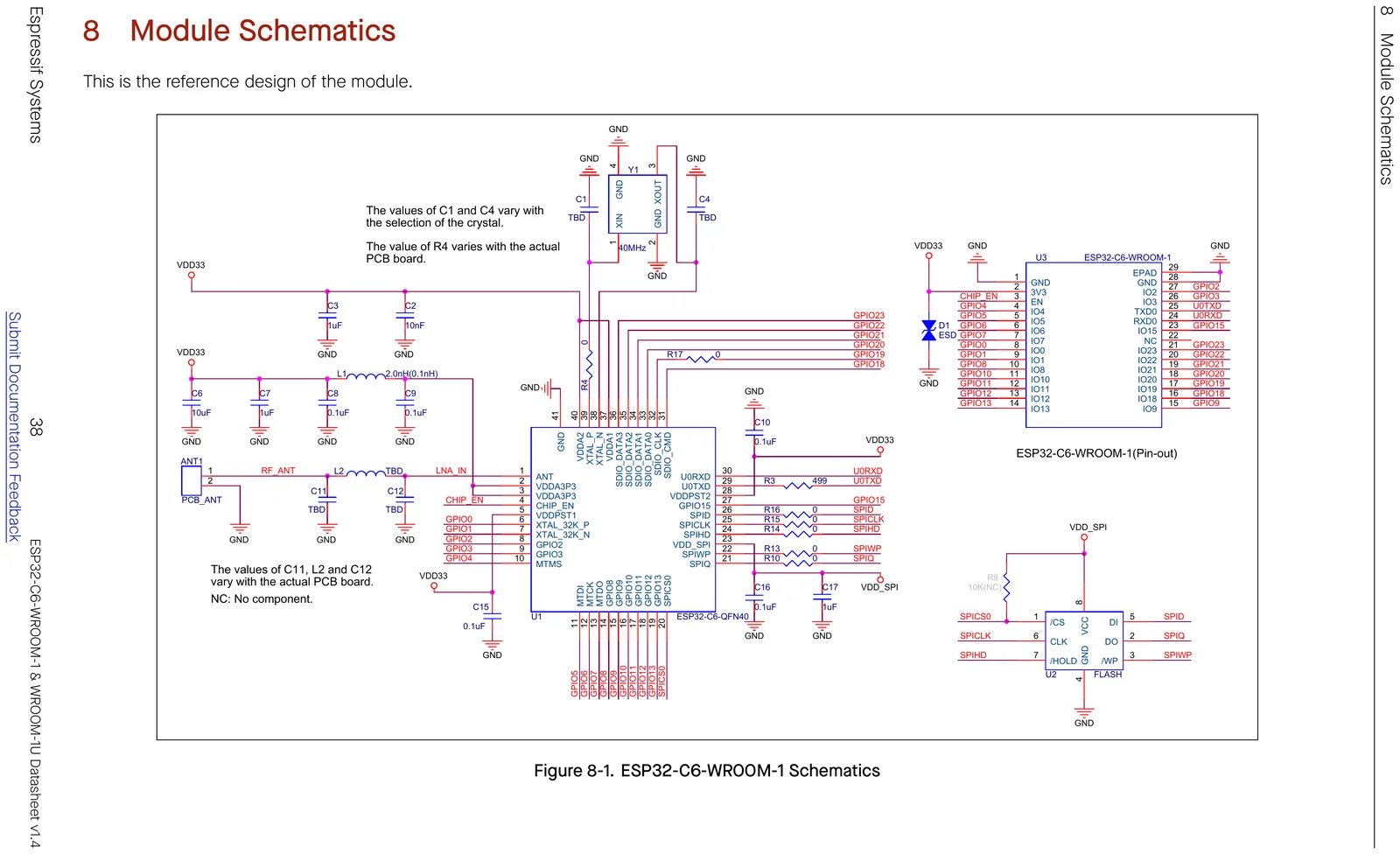
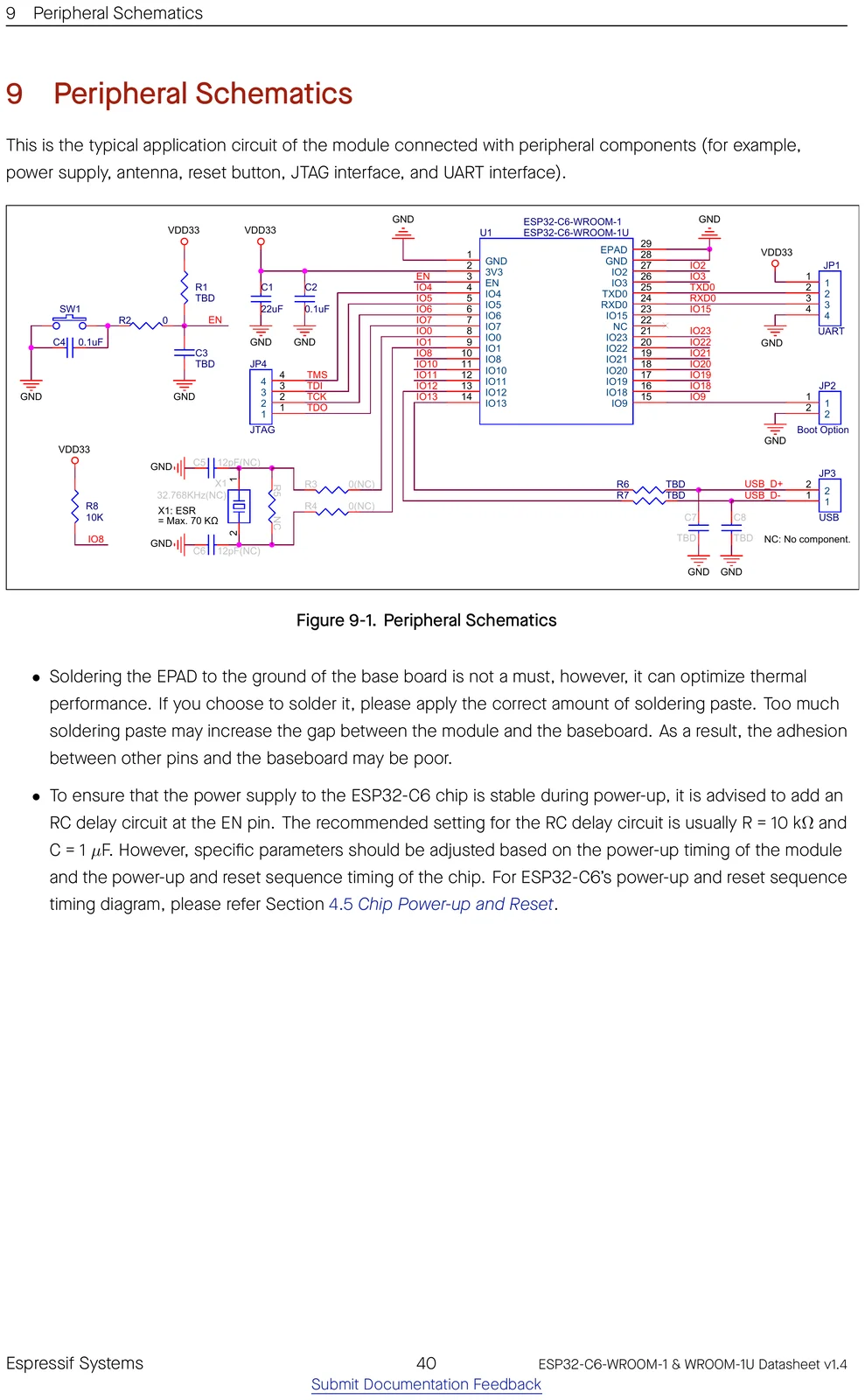
Schematics
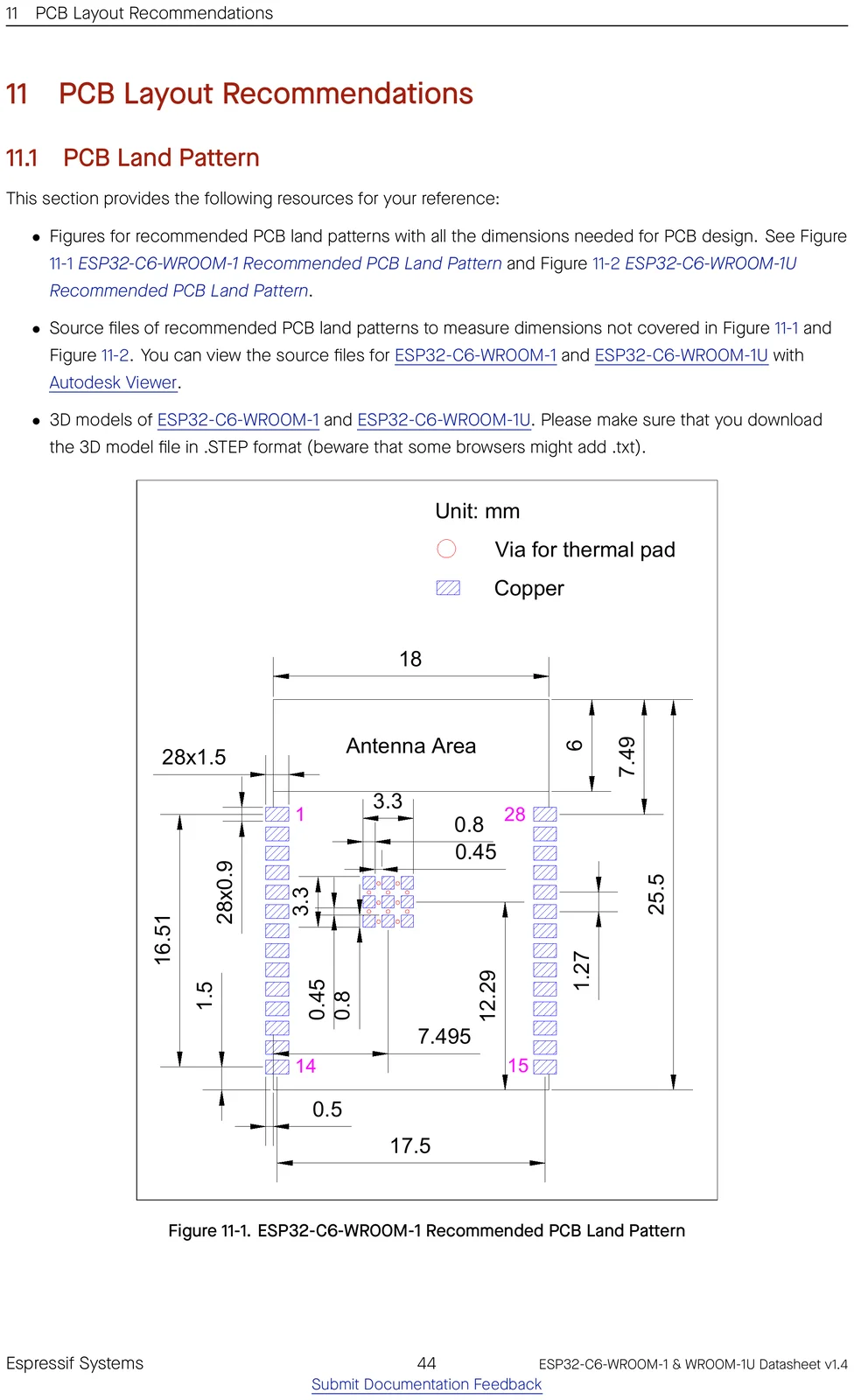
Mechanical & CAD
Getting started
Frameworks: Arduino-ESP32 core — fully supported · ESP-IDF 5.1+ (Espressif's official SDK) · MicroPython · Matter.
ESP-IDF target: idf.py set-target esp32c6.
The SoC has a built-in USB Serial/JTAG controller, so you can flash and debug over its native USB port with no external adapter.
Open-source projects using this module
Public GitHub projects whose KiCad design files reference the ESP32-C6-WROOM-1.
- cvonk/OPNpool ★ 97
Integrates the functionality of a Pentair pool controller into the smart home using ESP32 SoC.
- Tropaion/ZigBee_SmartMeter_Reader ★ 32
This is a ZigBee device to collect data from smartmeters using the DLMS/COSEM protocol.
- thehackbat/hackbat_esp32 ★ 12
Hackbat version based on the ESP32C6
- 74th/esp32-dev-boards ★ 6
ESP32 Dev Boards PCB
- ElectronicCats/badge-bsides-sandiego-2026 ★ 6
- melair/ktane ★ 5
Keep Talking and Nobody Explodes - Physical Edition
Frequently asked questions
Does the ESP32-C6-WROOM-1 have Wi-Fi and Bluetooth?
It provides 2.4 GHz Wi-Fi 6, Bluetooth LE and 802.15.4 (Thread/Zigbee).
How much memory does the ESP32-C6-WROOM-1 have?
It comes with 4, 8, 16 MB flash options and the ESP32-C6 has 512 KB of on-chip SRAM.
How many GPIO pins does the ESP32-C6-WROOM-1 have?
The module breaks out 23 GPIO, with up to 7 12-bit ADC channels. See the full pinout above.
Can I use the ESP32-C6-WROOM-1 with the Arduino IDE?
Yes — install the Arduino-ESP32 core and pick an ESP32-C6-based board. You can also use ESP-IDF 5.1 or MicroPython.
How do I flash the ESP32-C6-WROOM-1?
The SoC has a built-in USB Serial/JTAG controller, so you can flash and debug over its native USB port with no external adapter.
Is the ESP32-C6-WROOM-1 5 V tolerant?
No. It runs at 3.0-3.6 V and its GPIO are not 5 V tolerant — level-shift any 5 V signals.
Can I use an external antenna with the ESP32-C6-WROOM-1?
Most Espressif modules are also offered in a "-U" / "-1U" variant that swaps the on-board PCB antenna for a U.FL/IPEX connector for an external antenna — otherwise identical. Check this part's datasheet for the exact variant name.
Further reading
- ESP32-C6-WROOM-1 Datasheet
- ESP32-C6 modules
- Certificates for ESP32-C6-WROOM-1
- Espressif Product Selector
- ESP32-C6 Datasheet
- ESP32-C6 Technical Reference Manual
- ESP32-C6 product page
- ESP-IDF Programming Guide
- Hardware Design Guidelines
- ESP Dev-Kits documentation
- Espressif KiCad libraries (symbols/footprints/3D)